
7 design-led escapes worth travelling for
An edit of wildly handsome places to stay
Vermelho Hotel, Portugal

Located in the quiet coastal village of Melides, Portugal, Vermelho (meaning “red” in Portuguese) is famed shoe designed Christian Louboutin’s first hotel. The 13-room retreat feels like an intimate home, filled with treasures from the designer’s own collection: Spanish bargueño chests, Baroque ceramic appliqués, embroidered velvet sofas and azulejos in deep ocean blue. Designed in collaboration with architect Madalena Caiado and friend Carolina Irving, the building is intentionally understated from the outside, but richly detailed within – much like the Indian bangle that inspired its concept. Artisans from the Fábrica de Azulejos de Azeitão produced custom tiles for bedrooms and the deeply pigmented red flooring, using centuries-old techniques that remain central to Portuguese identity. Its most memorable attribute, after its photogenic good looks, might be its restaurant, Xtian, named for Louboutin but overseen by chef Emanuel Machado.
The RuMa Hotel and Residences, Malaysia

In the heart of Kuala Lumpur’s Golden Triangle, The RuMa Hotel and Residences is a sophisticated urban sanctuary where Malaysian heritage meets contemporary elegance. Named after the Malay word “rumah” for “home”, the hotel is a thoughtful tribute to the country’s rich cultural tapestry. Designed by Malaysian firm BEP Arkitek with interiors by Shanghai-based architecture and interior design firm MQ Studio, it artfully blends colonial-era grace with local craft traditions. Guests are welcomed by antique timber pillars salvaged from historic kampung homes, a dramatic terracotta birdcage entrance inspired by the country’s tin mining history and a custom-made golden kebaya sculpture by Malaysian designer Bernard Chandran. Warm copper ceilings, handwoven kelarai screens, rattan detailing and rich timber panelling create an intimate, tactile atmosphere throughout the 253 rooms and public spaces – a refined fusion of nostalgia, craftsmanship and modern restraint that feels like a truly luxurious home away from home.
Atlantis The Royal, Dubai

Rising dramatically on the crescent of Dubai’s Palm Jumeirah, Atlantis The Royal redefines ultra-luxury with bold, contemporary architecture by Kohn Pedersen Fox (KPF). Its striking stepped silhouette – a series of fragmented towers linked by a dramatic sky bridge and crowned by a 90-metre infinity pool – creates an instantly iconic presence while evoking the monumental arches and arcades of Roman aqueducts. The interlocking design also creates a myriad of naturally ventilated, shaded outdoor spaces for hotel guests, the result of which is a building that feels less like a hotel than its own indoor/outdoor, garden-strewn neighbourhood. Interiors by G.A Group draw inspiration from the nomadic Bedouin tribes of the Arabian desert who would traverse the landscapes using water wells as navigation, featuring sculptural water elements, delicate raindrop lighting and fluid transitions between indoor and outdoor living.
Rosewood São Paulo, Brazil

Out of the Cidade Matarazzo development – once a complex of 20th-century heritage buildings and now a vibrant mixed-use lifestyle centre – emerges an audacious, 93-meter-tall, 25-storey tower. Wrapped in wooden lattice and clad with over 10,000 growing trees indigenous to the Mata Atlântica rainforest, the Rosewood tower’s innovative design addresses urban environmental challenges by reintroducing native flora to the metropolitan landscape. Positioned adjacent to a renovated maternity ward, together the two buildings offer 160 guest rooms and over 100 resident suites, two pools and six restaurants. Rooms and public spaces maintain the brand’s signature “Sense of Place” philosophy, simultaneously commemorating Brazil’s rich past and sustainable future. Under the artistic direction of French designer Philippe Starck, interiors celebrate Brazilian talent: locally sourced woods, marbles from Bahia and Paraná, handcrafted furnishings by icons like Oscar Niemeyer and Sérgio Rodrigues, and nearly 450 works of art by over 50 Brazilian artists and artisans.
Benesse House, Japan

The revolutionary design concept behind Benesse House was created in 1992 by Tadao Ando, Pritzker Prize winner and among the most celebrated Japanese architects alive. Based on the concept of “coexistence of nature, art and architecture”, the complex comprises four distinct buildings – Museum (1992), Oval (1995), Park, and Beach – that integrate with the natural surroundings. Signature Ando elements define the experience: silky-smooth concrete walls, dramatic apertures that frame sea and sky views, controlled plays of light and shadow, and fluid transitions between interior spaces and the surrounding landscape. Dominated by minimalism and geometric simplicity, each of the 65 guest rooms spread between the buildings is spacious, defined by elements like understated furnishings and floor-to-ceiling windows that intentionally frame views of the sea, gardens and the distant Shikoku Mountains. Throughout, site-specific artworks by artists such as Richard Long and Yayoi Kusama are embedded into the architecture itself.
Villa Nai 3.3, Croatia

Carved into a hillside on Croatia’s remote Dugi Otok, Villa Nai 3.3 is an extraordinary example of architecture that disappears into its landscape. Nestled among a 40,000-square-meter olive grove from which an award-winning olive oil is cultivated, traditional Dalmatian building methods inspired the hotel’s undulating design, courtesy of renowned Croatian architect Nikola Bašić. The result is an almost undetectable fusion of edifice and environment, nearly invisible within the island’s rugged topography, that encourages guests to disappear into the natural setting. The building’s interiors are as elegant as their outdoor counterparts, enhanced with natural materials like Italian marble, wood finishes and muted hues that complement the hotel’s sustainable ethos. With only eight rooms and suites, Villa Nai 3.3 feels less like a hotel and more like an extension of the island itself: quiet, elemental and profoundly rooted in place.
The Ritz-Carlton Maldives, Fari Islands

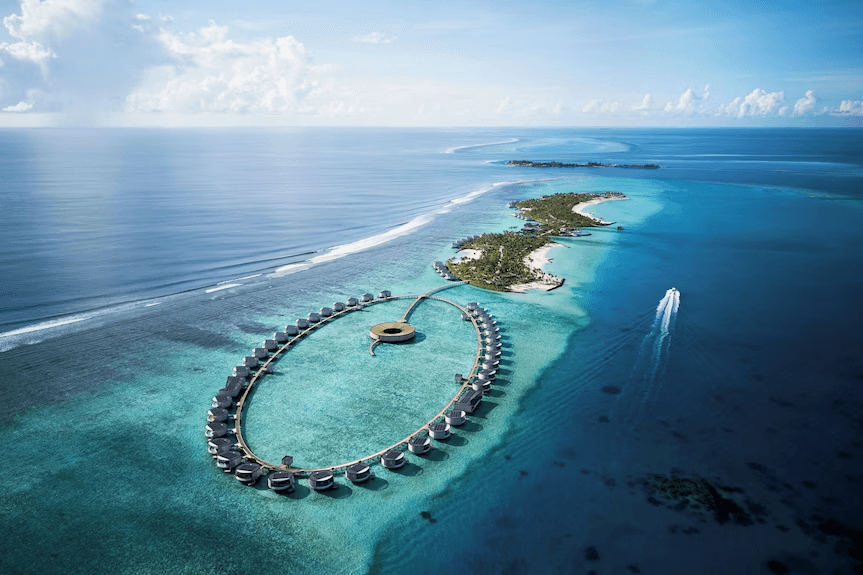
Created to mimic the motion of the ocean, all the resort’s one-bedroom villas are round with solar panels on top but the resort’s nine-room spa wows. In the centre of the lagoon, surrounded by circular overwater villas, the spa is shaped like a ring, with the middle open to the ocean it was modelled after. Its 100 beach and overwater villas are gracefully arranged around the lagoon and the central spa island, forming an iconic ring-shaped layout. Each villa features a private infinity pool, open-air lounge and panoramic floor-to-ceiling windows, while combining a restrained palette of local woods, textured stone floors and handcrafted elements drawn from Indian Ocean traditions to create fluid indoor-outdoor living that blur the boundaries between architecture and nature.
Also see: 9 quiet luxury hotels for your 2026 travel wish list
More Stories
Experience nostalgic Shanghai at Andaz Shanghai ITC hotel
The Luxury Chalet Company: Redefining the European winter escape
8 luxury hotel debuts defining travel in 2026
-5.jpg&w=3840&q=75)